Bushfire is part of many Australian forests, but not every fire leaves them healthier.
In many south-eastern Australian forests, post-fire regeneration can create dense, uniform regrowth that increases ladder fuels and crown fire risk.1 Where forests were already structurally altered before fire, recovery can entrench vulnerability.2
Early action matters
The first two to five years after fire are critical in shaping long-term ecological condition and fire behaviour outcomes.3–5
- Dense, even-aged regrowth can increase future fire severity.
- Weed invasion may accelerate after disturbance.
- Erosion risk increases following canopy loss, particularly on shallow and granitic soils.
Stabilising vulnerable sites, suppressing invasive species, and selectively shaping regeneration are more effective when undertaken early.
Restoring structural balance
Structurally diverse forests are generally less flammable than dense, even-aged stands. 1,6 Structural complexity also supports greater animal diversity by providing a greater range of habitats.7
However, since colonisation, the exclusion of First Nations fire, grazing, severe wildfire and other past land use practices have altered forest structure.
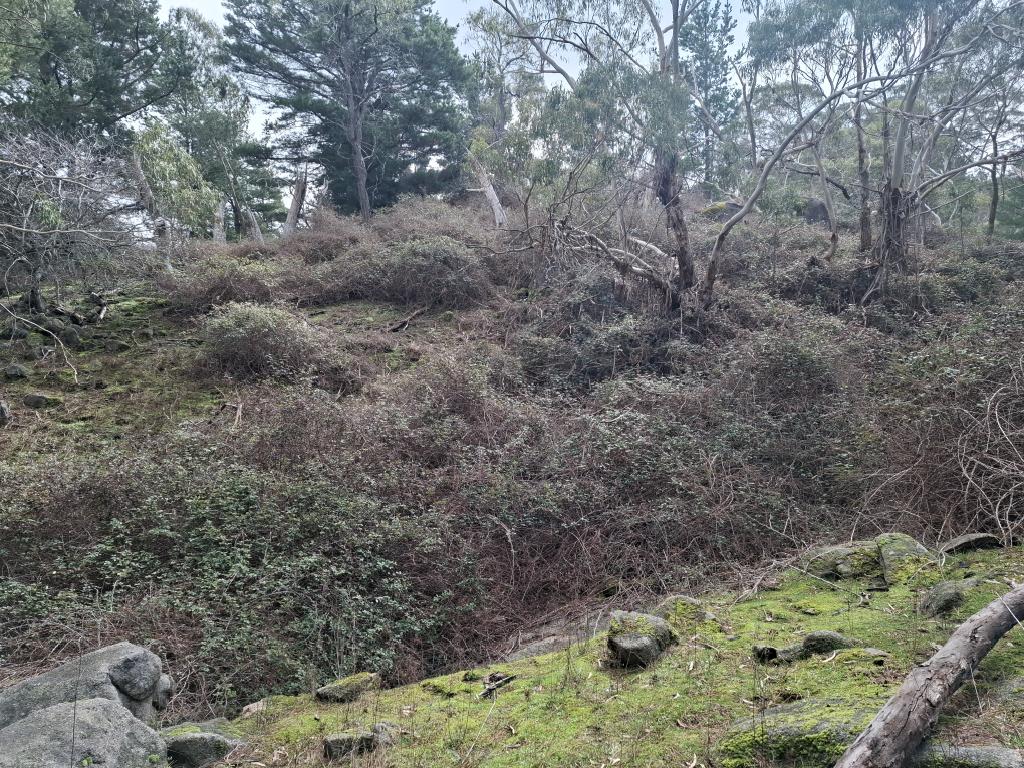
Weeds and ladder fuels: Mt Alexander before the fires
For example, in 2025, prior to the Harcourt fires, the Healthy Forests Foundation visited Mt Alexander on Dja Dja Wurrung Country to assess the health of the forests. We observed vulnerable, unhealthy forests in key locations. The observed structural and ecological characteristics of these forests included:
- patchy understorey condition, with areas of reduced structural balance
- evidence of browsing pressure, degrading the regeneration zones
- accumulated surface and ladder fuels in interface areas near private tenure
- granitic slopes with existing signs of sheet erosion and gully formation
- invasive woody weeds, including blackberry, gorse and briar rose.
While the recent fires have “reset” parts of the system, without targeted intervention the underlying structural and ecological weaknesses are likely to re-emerge.
At the Healthy Forests Foundation, we believe we should turn the devastation caused by fires into an opportunity. An opportunity to grow back better. Some of the ways this can be achieved include:
- determining what healthy is for that forest type, which should be done with First Nations knowledge holders, local knowledge and the best science available
- stabilising soils and protecting waterways
- identifying and protecting old and hollow-bearing trees, and other significant habitat attributes
- tackling invasive weeds and animals early
- restoring structural balance, including strategic restoration thinning to encourage more resilient healthy trees with less competition
- reintroducing cool cultural mosaic burning, especially when fuel levels are low.
Reintroducing First Nations cultural burning
Many small, seasonal mosaic burns are more effective than infrequent large perimeter burns.8–13 Patchy cultural burning can create fine-scale fuel breaks near township edges while protecting ground flora and culturally significant species.
But first forests need to be returned to a condition where cool cultural and mosaic burning can be safely applied under First Nations leadership. This is why it is important that recovery planning must:
- be co-designed with Firsts Nations knowledge owners
- recognise cultural authority for fire on Country
- integrate cultural mapping before operational decisions.
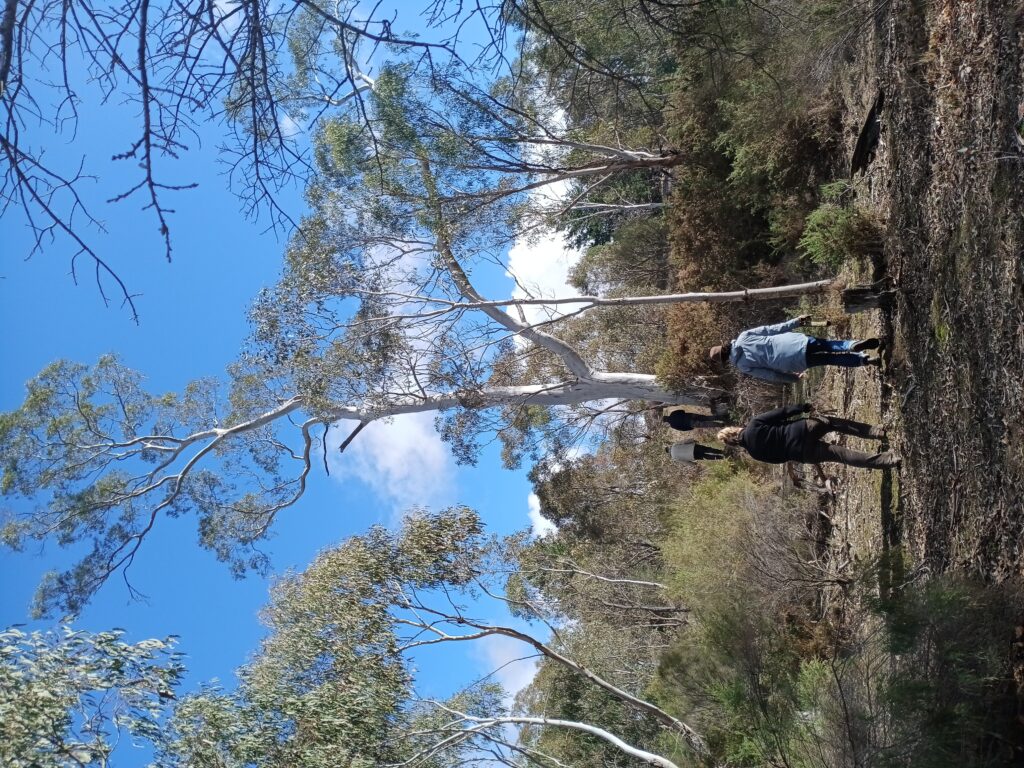
Mt Alexander before the fires
A township–Country model
Growing back better following fire also presents another opportunity, a social opportunity. This is because community protection is strongest when Country is healthy. First Nations knowledge holders and community members can help shape the forests important to them, giving a sense of ownership and place. To achieve this we need to integrate:
- public land stabilisation
- private land interface management
- cross-tenure coordination
- community participation in seasonal burning programs.
Growing back better aligns ecological restoration with fire resilience, cultural leadership and community safety.
REFERENCES
- Taylor, C., McCarthy, M. A., & Lindenmayer, D. B. (2014). Nonlinear effects of stand age on fire severity. Conservation Letters, 7, 355–370. https:
// doi .org /10 .1111 /conl .12122 - Keith, D. A., Allen, S. P., Gallagher, R. V., Mackenzie, B. D. E., Auld, T. D., Barrett, S., Buchan, A., English, V., Gosper, C., Kelly, D., McIllwee, A., Melrose, R. T., Miller, B. P., Neldner, V. J., Simpson, C. C., Tolsma, A. D., Rogers, D., Van Leeuwen, S., White, M. D., … Tozer, M. G. (2022). Fire‐related threats and transformational change in Australian ecosystems. Global Ecology and Biogeography, 31(10), Article 10. https:
// doi .org /10 .1111 /geb .13500 - Dickman, C. R. (2021). Ecological consequences of Australia’s “Black Summer” bushfires: Managing for recovery. Integrated Environmental Assessment and Management, 17(6), 1162–1167. https:
// doi .org /10 .1002 /ieam .4496 - Gallagher, R. V., Allen, S. P., Mackenzie, B. D. E., Keith, D. A., Nolan, R. H., Rumpff, L., Gosper, C. R., Pegg, G., van Leeuwen, S., Ooi, M. K. J., Yates, C. J., Merow, C., Williams, R. J., Nikolopoulos, E. I., Beaumont, L. J., & Auld, T. D. (2022). An integrated approach to assessing abiotic and biotic threats to post-fire plant species recovery: Lessons from the 2019–2020 Australian fire season. Global Ecology and Biogeography, 31(10), 2056–2069. https:
// doi .org /10 .1111 /geb .13478 - Legge, S., Woinarski, J. C. Z., Scheele, B. C., Garnett, S. T., Lintermans, M., Nimmo, D. G., Whiterod, N. S., Southwell, D. M., Ehmke, G., Buchan, A., Gray, J., Metcalfe, D. J., Page, M., Rumpff, L., Van Leeuwen, S., Williams, D., Ahyong, S. T., Chapple, D. G., Cowan, M., … Tingley, R. (2022). Rapid assessment of the biodiversity impacts of the 2019–2020 Australian megafires to guide urgent management intervention and recovery and lessons for other regions. Diversity and Distributions, 28(3), 571–591. https:
// doi .org /10 .1111 /ddi .13428 - Zylstra, P., Wardell-Johnson, G., Falster, D., Howe, M., McQuoid, N., & Neville, S. (2023). Mechanisms by which growth and succession limit the impact of fire in a south-western Australian forested ecosystem. Functional Ecology, 37(5), 1350–1365. https:
// doi .org /10 .1111 /1365 -2435 .14305 - Lindenmayer, D. B., & Laurance, W. F. (2017). The ecology, distribution, conservation and management of large old trees. Biological Reviews of the Cambridge Philosophical Society, 92(3), 1434–1458. https:
// doi .org /10 .1111 /brv .12290 - Burrows, N., Stephens, C., Wills, A., & Densmore, V. (2021). Fire mosaics in south-west Australian forest landscapes. International Journal of Wildland Fire, 30(12), 933–945. https:
// doi .org /10 .1071 /WF20160 - Corey, B., Andersen, A. N., Legge, S., Woinarski, J. C. Z., Radford, I. J., & Perry, J. J. (2020). Better biodiversity accounting is needed to prevent bioperversity and maximize co‐benefits from savanna burning. Conservation Letters, 13(1), e12685. https:
// doi .org /10 .1111 /conl .12685 - Holland, G. J., Clarke, M. F., & Bennett, A. F. (2017). Prescribed burning consumes key forest structural components: Implications for landscape heterogeneity. Ecological Applications, 27(3), 845–858. https:
// doi .org /10 .1002 /eap .1488 - Nimmo, D. G., Andersen, A. N., Archibald, S., Boer, M. M., Brotons, L., Parr, C. L., & Tingley, M. W. (2022). Fire ecology for the 21st century: Conserving biodiversity in the age of megafire. Diversity and Distributions, 28(3), 350–356. https:
// doi .org /10 .1111 /ddi .13482 - Parr, C. L., & Andersen, A. N. (2006). Patch Mosaic Burning for Biodiversity Conservation: A Critique of the Pyrodiversity Paradigm. Conservation Biology, 20(6), 1610–1619. https:
// doi .org /10 .1111 /j .1523 -1739 .2006 .00492 .x - Wysong, M., Legge, S., Clark, A., Maier, S., Bardi Jawi Rangers, Nyul Nyul Rangers, Yawuru Country Managers, Cowell, S., & Mackay, G. (2022). The sum of small parts: Changing landscape fire regimes across multiple small landholdings in north-western Australia with collaborative fire management. International Journal of Wildland Fire, 31(2), 97–111. https:
// doi .org /10 .1071 /WF21118
Active conservationCase studiesHealthy forestsPositive actions