Australia’s forests are one of our greatest climate assets. They already hold immense stores of carbon, but under a warming climate their ability to absorb and retain more carbon is being challenged. Hotter, drier conditions reduce growth rates and increase the risk of catastrophic fire, pests and dieback.¹–³ Left unmanaged, many forests will struggle to sequester carbon at the levels needed to meet national targets.
Our analysis shows that by proactively managing around 37 million hectares of native forests (about 29% of the estate) Australia can deliver ~93 MtCO₂ per year by 2050, meeting the land-sector’s contribution to climate goals. Importantly, this pathway works with the forests we already have, avoiding the need to clear land for new plantations.
What proactive forest management means
Proactive forest management is about restoring the health of stressed forests while safeguarding those still in good condition. It includes:
- Cultural and prescribed burning – reinstating First Nations fire and forest management stewardship to restore habitat diversity and reduce destructive wildfire risk⁴
- Targeted ecological interventions – such as thinning in overcrowded forests where appropriate, or pest and weed control where invasives dominate⁵,⁶
- Ongoing monitoring – using satellite and field-based data to track forest health so we can respond quickly to signs of decline.⁷
Not all forests need direct intervention. Some will be left under passive protection, but monitoring having systems in place means we can act early if conditions change
Why planting alone is not enough
Tree planting can play a supporting role, but it cannot deliver the scale or speed of carbon removals required. New plantings take decades before they sequester significant carbon, and meeting 2050 targets through planting alone would require 9–15 million hectares of new plantings, often on land competing with food production.³ Mature trees in existing forests absorb and store far more carbon immediately, and with climate pressures reducing growth rates even in healthy forests,¹–³ restoring the carbon function of the native estate is the faster and more reliable pathway. New environmental plantings will also need proactive management to stay healthy; without it, they risk the same vulnerabilities as degraded native forests.⁴–⁶
What the numbers show
Australia has 133.6 million hectares of forest, including 131.5 million hectares of native forest.¹ The Foundation’s conservative modelling shows only one in 4 hectares of this needs to be proactively managed to achieve Australia’s land-sector climate targets. Our conservative modelling shows:
- by 2035, 12.7 million hectares proactively managed (~ 9.7% of the estate) will sequester an additional ~37 MtCO₂/yr
- by 2050, 37 million hectares proactively managed (~28% of the estate) will sequester an additional ~93 MtCO₂/yr
- more than 70% of native forests remain under passive protection and monitoring
- even in conservative scenarios, proactive management delivers ~78% of the carbon target, with only ~2.6 Mha of new plantings required compared to 9–15 Mha under planting-only strategies.³
The below example is a scenario generated through our analysis. This scenario is based on a degraded eucalypt tall open forest, with 1.5°C warming and subject moderate management. In this example the proactively managed forest outperforms both reforestation and no management.
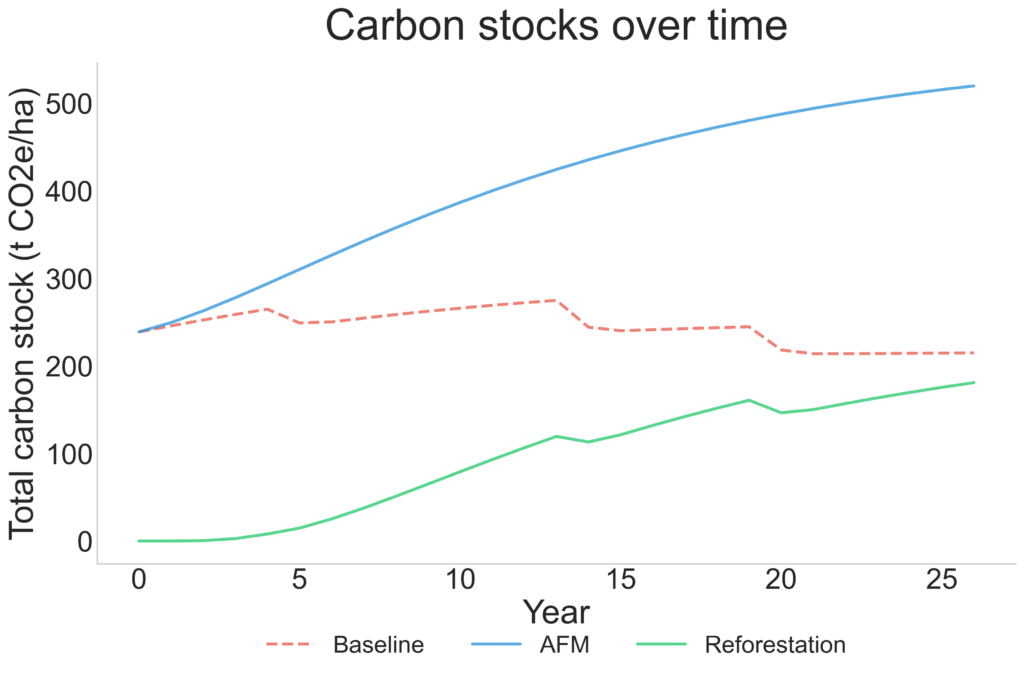
Model scenario is based on a degraded eucalypt tall open forest (ETOF) under the Paris climate path of +1.5°C: comparison is between baseline, reforestation and moderate proactive forest management (AFM). In this scenario proactive forest management has better carbon outcomes.
To find out more open our analysis and to access our open source tool click here.
Active conservationResearchValuing forests and economics